
Bell County 72-Hour Release Access
Bell County provides an official Inmate Inquiry portal, but no distinct official “released in the last 72 hours” URL was found. Its date range selects booking dates, not actual release dates. A three-day booking search can therefore include people still held and omit people booked earlier but released inside the target window.
The official jail page calls this a list of inmates and says it is updated hourly. That cadence supports a current snapshot, not a rolling archive or one-hour guarantee for posting a physical release.
Check Bell County's Three-Day Window
Define whether “three days” means three calendar dates or the preceding 72 hours. Use Central Time and exact endpoints so the custodian can identify existing records without creating a new analysis.
- Write the inclusive start and end timestamps.
- Use the Sheriff NextRequest portal to ask for an existing release report or jail-register entries.
- State that selection must use actual release time, not booking date.
- Request name, subject and booking numbers, actual release time, release type, and destination.
- For one person, open all matching portal bookings and compare the custody flag, scheduled date, and actual release field.
- Call 254-933-5402 or Booking/Intake at 254-933-5450 if the records conflict.
For one named person across several systems, use the Bell County released inmates search guide. The 24-Hour Release List method is better for a same-day interval.
Bell County Three-Day Release Fields
No public three-day list has a fixed field set. Ask for the following releasable fields from an existing report, booking/release sheet, or jail-register entry.
| Field | What it shows |
|---|---|
| Name and subject number | Identifies the county subject and reduces same-name errors. |
| Booking number and date | Ties the release to one custody episode. |
| Actual release timestamp | Places the event inside or outside the requested window. |
| Release type | Describes the agency's coded basis without guesswork. |
| Destination or receiving agency | Separates community release from continued custody. |
| Bond and disposition | Adds case context but does not prove physical release time. |
Portal results may also show a photo, custody flag, scheduled date, physical descriptors, and multiple-booking status. Detail records can add actual release, charges, arresting agency, bond, and disposition. Field availability varies.
Bell County Weekend Release Review
A Friday-through-Monday interval crosses clerk hours and several calendar dates. Bell County's District Clerk bond page says a cash-bond receipt goes to the jail during clerk hours, Monday through Friday from 8 a.m. to 5 p.m., excluding holidays. When the clerk is closed, the jail can take a cash bond.
Posting starts release processing. Another case, warrant, parole action, detainer, or transfer may prevent community return. A court order may also authorize release before jail staff complete it. Test the three-day window with the actual county timestamp, not the bond receipt or order time.
Bell County's Permanent Release Register
Texas Local Schedule PS item PS4200-06 makes the county jail register permanent and requires a release or transfer date. This is the authoritative archive fallback when web visibility changes. It does not promise that portal rows stay public or that all supporting records are permanent.
The listed custodian is Michelle Sanchez, 104 S. Main St., Belton, TX 76513, 254-933-5533. Ask for electronic copies and a written cost estimate. Bell County posts no fixed fee or guaranteed completion time for this release-record request.
Texas IVSS-Counties can send future custody or court alerts for a named county record, but it is not a past three-day list. TDCJ's web search includes current state prisoners only. Neither replaces the Bell County register.
Bell County Release or Transfer
Movement from Central Jail to Loop Jail is not community release. Transfer to TDCJ, another county, USMS, BOP, or ICE ends the Bell County episode while custody continues. A scheduled date is also only a forecast. The destination field is therefore essential in a three-day set.
| Signal | Safe conclusion |
|---|---|
| Actual time and community release type | The county episode is recorded as ended. |
| Transfer and receiving agency | County custody ended; custody continued elsewhere. |
| Scheduled release date | A forecast, not proof of exit. |
| Still in custody | The current county snapshot has not recorded departure. |
| No portal result | Ambiguous; check the register and court record. |
Keep the agency's own label rather than calling every departure “released.” The court docket can explain the legal action, while the jail record supplies the physical event.
Bell County 72-Hour Data Limits
The portal does not publish post-release retention. Live tests found in-custody records even when the custody control was unchecked or omitted. This makes the search form unsuitable as a release-list builder. Record access times and preserve booking identifiers for follow-up.
The source image below comes from the Texas State Library retention schedule.
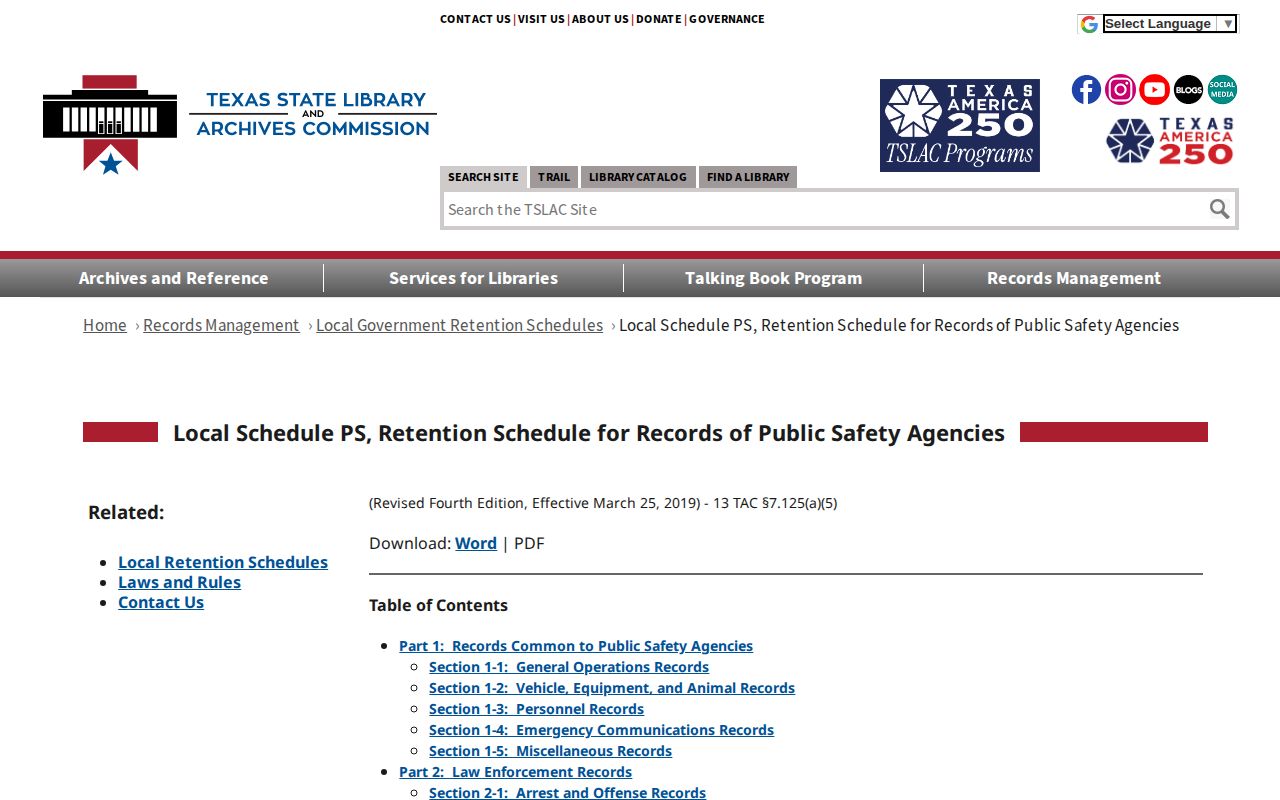
It supports the permanent register fallback, not a claim that Bell County offers a public rolling 72-hour web archive.
A careful request should also ask the agency to identify any standard computer-generated daily release report it can produce without custom programming. If no such report exists, jail-register entries within the stated interval remain the narrower target. Asking for an existing record avoids turning a public-information request into a question that staff must research or answer.
When a result appears near either endpoint, compare the exact actual release time rather than the booking date or the time a court order was signed. Keep the subject and booking number with the conclusion. Bell County records can contain several episodes for one person, and a release tied to an older episode must not be assigned to a later stay.
Bell County Court and Jail Timing
The official Bell County Odyssey portal can show a bond order, dismissal, judgment, sentence, or later court action after a jail row is hard to find. That court record explains the legal case event. It does not state the exact moment jail staff completed release. Pair it with the booking/release sheet or register entry rather than choosing one source and ignoring the other.
Jurisdiction determines the clerk. Felony district matters route to the District Clerk, while county-level misdemeanor matters route to the County Clerk. Search by cause number when possible because common names create false matches. A three-day list should not add a disposition inferred from a similarly named court case.
If the jail says transfer, continue with the receiving system. TDCJ requires its current-only offender search or a historical information request. A federal transfer may require the BOP locator and Western District of Texas docket. An immigration handoff requires a separate ICE ODLS check. Those later records do not change Bell County's timestamp, but they explain why county departure was not community release.
Municipal custody adds another boundary. A Temple, Killeen, Belton, or other city arrest can end in direct release or transfer before a Bell County booking appears. If no county episode exists, contact the arresting police records unit and municipal court. Do not force a city event into a county 72-hour report that never recorded it.
Use restrained publication language after the review. “Bell County records show the booking ended” stays tied to the source. “Not on the roster” does not. If the destination is unknown, say that it is unknown. A three-day window improves coverage around weekends, but it cannot cure a missing destination, mistaken identity, or an agency-feed delay.
Keep a log for each of the three days rather than overwriting earlier observations. Note the portal access time, booking number, actual release field, and any receiving agency. When the county later supplies the requested report, reconcile each observation against that official set. A changed web row may reflect an update, while the permanent register preserves the formal end event. Keep both records.
Public Record Search
Sponsored Results